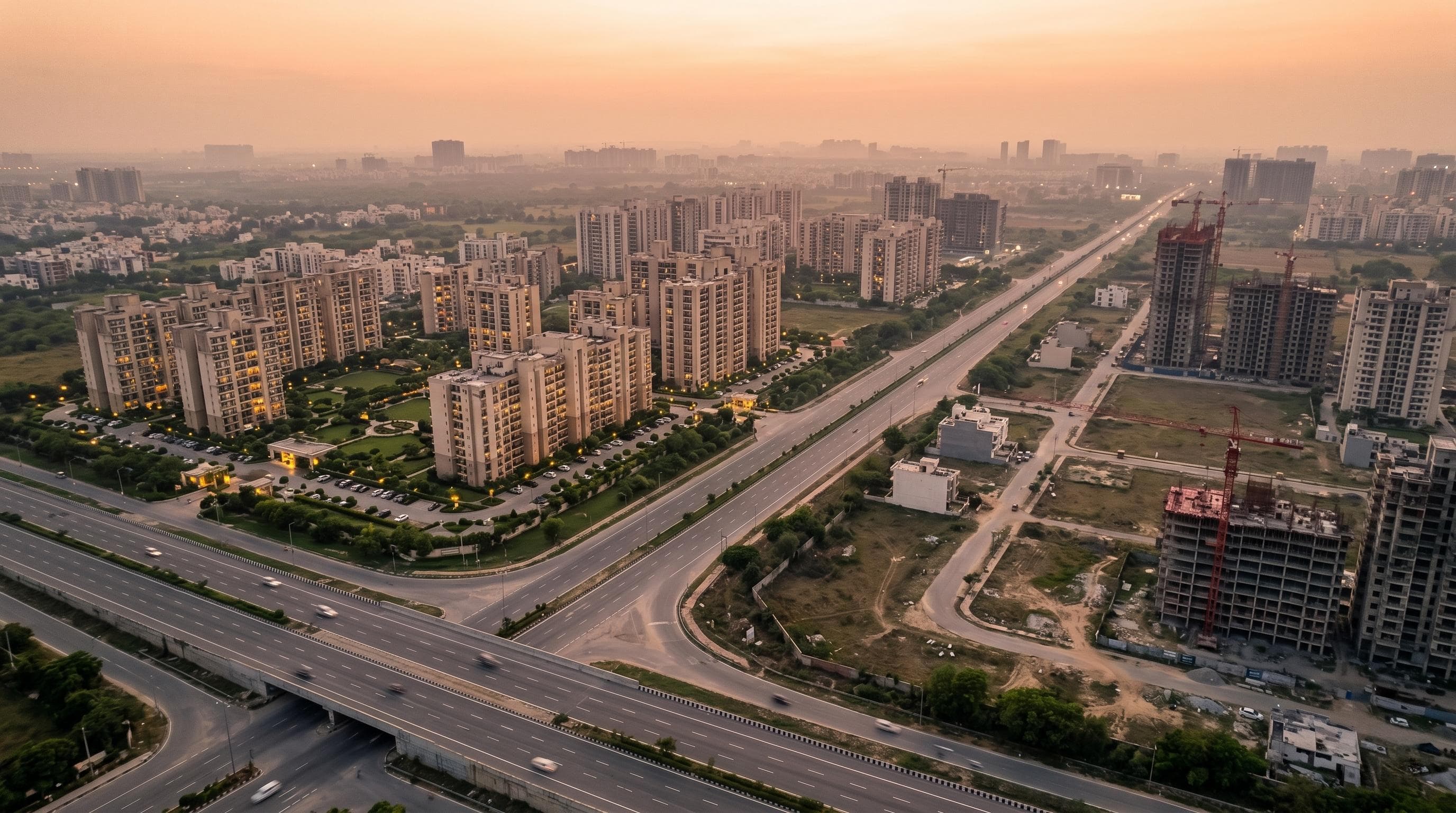

The gross rental yield a broker shows you and the net yield you actually deposit each month are rarely the same number. In Gurgaon's premium corridors, the gap between the two can be as wide as 1.5 percentage points. A 3.5 percent gross yield can shrink to 2.2 percent net by the time CAM charges, property tax, repairs, vacancy periods, and insurance are accounted for.
That gap is precisely where most Gurgaon landlords quietly lose returns they never knew they had. The ranking below is built the way a serious investor builds a rental portfolio: net of every deduction that actually lands on a landlord's annual statement. The four corridors ranked are Dwarka Expressway, SPR, Golf Course Extension Road, and New Gurgaon. The results for 2026 are not what the headline numbers suggest.
What Is Net Yield, and Why Gross Numbers Lie
Net yield is the annual rental income a landlord actually retains, expressed as a percentage of the property's purchase value. The formula is straightforward but rarely applied honestly in Gurgaon listings.
Net Yield = (Annual Rent minus CAM minus Property Tax minus Insurance minus Repairs minus Vacancy Allowance) divided by Purchase Price, times 100.
The deductions most Gurgaon landlords fail to model accurately are:
- CAM (Common Area Maintenance), ranging from Rs 3 per sq ft per month in basic projects to Rs 18 per sq ft per month in ultra-luxury towers
- Property tax, typically Rs 15,000 to Rs 30,000 per year for a mid-size 3 BHK
- Vacancy allowance of 5 to 8 percent of annual rent, which is inevitable between tenancies
- Repairs, depreciation, and fit-out refreshes between tenants, averaging 3 to 5 percent of annual rent
In Gurgaon's premium segment, these deductions routinely consume 25 to 35 percent of gross rent. That is the difference between what a listing shows you and what your bank account actually sees. Understanding this gap is the first step toward making a real Gurgaon real estate investment decision in 2026.
The 2026 Net Yield Ranking
After stripping out all deductions and weighting for tenant quality, vacancy risk, and rent escalation potential, here is how the four corridors rank for 2026. Data reflects typical mid-to-premium 3 BHK configurations in each corridor.
| Rank | Corridor | Entry (Rs/sqft) | Rent (Rs/sqft/mo) | Gross Yield | CAM (Rs/sqft) | Net Yield | Risk |
|---|---|---|---|---|---|---|---|
| #1 | SPR (Southern Peripheral Road) | 15,000 to 22,000 | 55 to 75 | 3.2 to 3.8% | 5 to 8 | 3.0% | Low to Moderate |
| #2 | Dwarka Expressway | 12,000 to 18,000 | 45 to 60 | 3.0 to 3.5% | 4 to 7 | 2.7% | Moderate |
| #3 | Golf Course Extension Road | 18,000 to 24,000 | 60 to 80 | 2.8 to 3.2% | 10 to 15 | 2.6% | Low |
| #4 | New Gurgaon (Sectors 79 to 95) | 8,000 to 12,000 | 25 to 35 | 3.0 to 3.5% | 4 to 6 | 2.4% | Moderate to High |
The highest gross yield does not deliver the highest net yield. CAM, vacancy, and tenant quality decide the podium.
Corridor Deep Dives: How Each Corridor Earns Its Rank
Rank 1: SPR, the Dark Horse of 2026
The Southern Peripheral Road has quietly moved to the top of the net yield ranking this year, driven by an unusual combination of moderate entry prices, rising rents, and manageable CAM. A 3 BHK on SPR today trades at Rs 15,000 to Rs 22,000 per sq ft, with monthly rents of Rs 55 to Rs 75 per sq ft. Gross yields sit at 3.2 to 3.8 percent. Because SPR projects tend to run CAM at Rs 5 to Rs 8 per sq ft, significantly lower than GCER or Golf Course Road, net yields stay strong at approximately 3.0 percent.
What makes SPR the dark horse is tenant quality. The corridor's proximity to Cyber City, Udyog Vihar, and the fast-growing GCC cluster along Sohna Expressway ensures stable, upward-trending demand from mid-to-senior IT and BFSI professionals. Vacancy periods are short, rent escalations are steady, and company-leased inventory is growing. The best sectors in Gurgaon for rental income in 2026 increasingly point to SPR micro-markets.
Rank 2: Dwarka Expressway
DXP comes in second at approximately 2.7 percent net yield. The corridor still offers the most attractive entry prices in Gurgaon at Rs 12,000 to Rs 18,000 per sq ft for delivered 3 BHK inventory. Monthly rents track at Rs 45 to Rs 60 per sq ft, producing a 3.0 to 3.5 percent gross yield, and CAM stays modest at Rs 4 to Rs 7 per sq ft.
The reason DXP trails SPR despite lower entry is tenant depth. Rental demand on DXP is still maturing as the corridor absorbs its large delivered inventory. As more residents move into Diplomatic Enclave II-adjacent sectors, landlord negotiation power will strengthen and net yields should converge with SPR by 2027.
Rank 3: Golf Course Extension Road
GCER sits third at around 2.6 percent net, despite commanding the highest absolute rents of the four corridors at Rs 60 to Rs 80 per sq ft per month. The reason is CAM. GCER's premium towers carry maintenance charges of Rs 10 to Rs 15 per sq ft per month, which wipes out much of the rent advantage. Higher entry prices of Rs 18,000 to Rs 24,000 per sq ft further compress the yield ratio.
GCER remains excellent for buyers prioritising tenant quality, capital stability, and low vacancy risk. For pure rental income optimisation, it is no longer the category leader.
Rank 4: New Gurgaon
New Gurgaon delivers the lowest net yield at approximately 2.4 percent, despite offering the lowest entry prices at Rs 8,000 to Rs 12,000 per sq ft. The headline gross yield of 3.0 to 3.5 percent is misleading because absolute rents stay thin at Rs 25 to Rs 35 per sq ft, vacancy periods are longer due to a shallower tenant pool, and rent escalations lag the more commercial-adjacent corridors. New Gurgaon remains a strong appreciation play, but it is not the highest-ROI property in Gurgaon for landlords focused on rental income alone.
Metro Connectivity and GCC Clusters: The Two Forces Shaping 2026 Yields
Two structural drivers explain why the 2026 rankings look the way they do.
First, metro connectivity. Properties within a 500-metre radius of a functional metro station consistently command a 15 to 20 percent rental premium over comparable projects a kilometre away. The Rapid Metro network across Golf Course Road, the expanded DMRC presence along HUDA City Centre, and the planned metro extensions into SPR and Sohna Expressway are reshaping rental demand. Corridors slated for metro connectivity by 2028, particularly SPR and parts of DXP, are already seeing visible rent acceleration.
Second, Global Capability Centres. Gurgaon now hosts over 250 GCCs, housing nearly 40 percent of India's GCC workforce. These multinational centres cluster around Cyber City, Udyog Vihar, Sector 44, and the rapidly growing SPR commercial belt. Senior GCC employees and expat postings drive the premium rental segment in Gurgaon, and they deliberately choose residential corridors within a 20-minute commute of their office. SPR sits precisely inside this commute band. DXP is at the outer edge of it. GCER and Golf Course Road are beyond it for most GCC addresses.
Rental Yield vs Capital Appreciation: Picking Your Return Mix
Rental yield is only one half of total return. Capital appreciation is the other. The yield versus appreciation trade-off plays out differently across the four corridors, and the right answer depends entirely on what you are trying to solve for.
- For pure yield optimisers: SPR delivers the strongest net income today, followed by DXP.
- For a balanced mix: DXP and SPR both offer 12 to 15 percent appreciation CAGR alongside healthy net yield.
- For pure appreciation, with accepted lower yield: Golf Course Road and select New Gurgaon sub-pockets remain relevant.
The smart 2026 portfolio does not pick only one. It allocates across two corridors with complementary return drivers. Most high-performing portfolios held by Realty Canvas clients carry one appreciation-focused asset and one yield-focused asset, balancing cash flow with long-horizon capital gain.
Request an Investment Portfolio Audit
If you already own Gurgaon rental property, or you are about to, the difference between gross yield and net yield determines whether you are building wealth or quietly losing it to CAM, vacancy, and tenant churn. Realty Canvas has advised on over 2,000 Gurgaon transactions across two decades of market cycles.
Book a complimentary portfolio audit at realtycanvas.in and speak with an advisor. We calculate your exact net yield, benchmark it against 2026 corridor data, and recommend the one or two changes that produce the largest income improvement for your portfolio.